Diabetic retinopathy
Retinopathy is damage to the blood vessels of the retina caused by long-term high blood glucose. In developed countries, it is the most common cause of blindness in working-age adults. However, it is preventable and treatable — and a great deal depends on the patient.
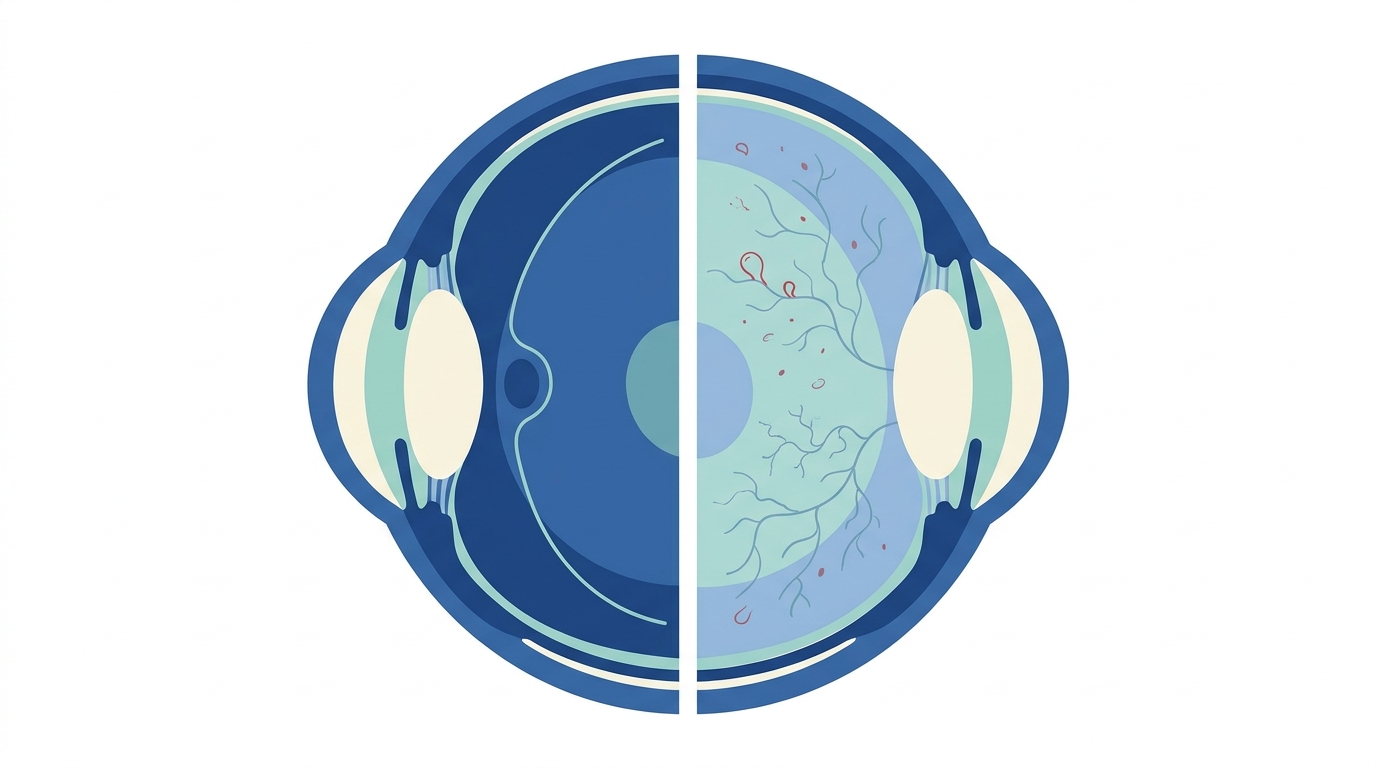
What is diabetic retinopathy?
The retina is a layer of light-sensitive cells that carries the visual signal to the brain. The retina is supplied by tiny blood vessels. Long-term high blood glucose damages the walls of these vessels — they become leaky, narrow and may rupture. The result is blurred vision, small dark spots ("floaters") in the visual field and, over time, complete vision loss.
Statistics: everyone who has had diabetes for 20+ years has detectable retinopathy. In patients with type 1 diabetes the first changes typically appear 5 years after diagnosis, while in type 2 diabetes changes may already be present at the time of diagnosis.
Stages
Retinopathy develops step by step:
- Non-proliferative retinopathy (NPDR) — early changes. Tiny bulges form in vessel walls (microaneurysms), small haemorrhages and yellow spots (exudates) may appear. Vision is often normal.
- Moderate NPDR — more microaneurysms and haemorrhages, some vessels are occluded.
- Severe NPDR — many vessels are blocked. Parts of the retina lose their blood supply (ischaemia). Vision may still be normal but the risk of vision loss is high.
- Proliferative retinopathy (PDR) — ischaemia stimulates the growth of new, abnormal vessels (neovascularisation). These new vessels are fragile and can rupture, causing vitreous haemorrhage and, eventually, retinal detachment (the retina separates from the back of the eye).
- Diabetic macular oedema (DME) — accumulation of fluid in the central part of the retina (macula), which is responsible for sharp vision. It can occur at any stage of retinopathy and is the most common cause of vision loss.
Symptoms
An important point about retinopathy: the early stages are completely symptom-free. The patient feels and sees nothing unusual, even though the retina is already damaged. When symptoms do appear, they are:
- Blurred or distorted central vision (a sign of DME)
- Black spots or "floaters" in the visual field (blood that has leaked into the vitreous)
- Dark patches in the visual field
- Reduced night vision
- Changes in colour perception
- Sudden partial or total vision loss (severe haemorrhage or retinal detachment — requires immediate medical attention)
Diagnosis
There are two main methods for diagnosing retinopathy:
- Retinal photography (fundoscopy) — we photograph the retina with a digital camera and assess microaneurysms, haemorrhages, exudates and neovascular vessels. The method is well-suited for screening and we offer it on-site during your appointment.
- Optical coherence tomography (OCT) — uses light scanning to produce a cross-sectional image of the retina. Especially useful for diagnosing macular oedema. Performed by an ophthalmologist.
Depending on the type and duration of diabetes, we recommend:
- Type 1 diabetes: first retinal exam 5 years after diagnosis, then once a year.
- Type 2 diabetes: exam immediately at diagnosis and then once a year (or more often if changes are found).
- Gestational diabetes or pregnancy in a diabetic patient: every 3 months.
Treatment
Treatment depends on the stage:
- Early stages: lower blood glucose, blood pressure and cholesterol. Often no other treatment is needed, just regular monitoring.
- Severe NPDR and PDR: laser photocoagulation (laser coagulation "burns" ischaemic areas of the retina to slow or stop the growth of new vessels). Performed by an ophthalmologist.
- Diabetic macular oedema: intravitreal anti-VEGF injections (ranibizumab, aflibercept, brolucizumab) — reduce swelling and improve vision. Performed by an ophthalmologist.
- Vitreous haemorrhage or retinal detachment: vitrectomy — surgery in which the vitreous is removed and the retina is reattached.
How to prevent it?
Preventing retinopathy is simple — but requires constant attention:
- Keep HbA1c within target (< 7%, ideally 6.5%)
- Control blood pressure — should stay below 130/80 mmHg
- Keep LDL cholesterol < 2.6 mmol/L (lower if complications are already present)
- Stop smoking — smoking accelerates retinopathy
- Attend regular retinal screening.
At our clinic
At Tallinn Endocrinology Clinic we perform retinal photography on-site during the appointment. The service is available both via Estonian Health Insurance (with referral, as part of a package) and as a paid service (€50 for both eyes) or in a package for €110 (visit + HbA1c + retinal photography). If we find changes, we refer you to an ophthalmologist immediately.
Need personal advice?
The endocrinologist and nurses at Tallinn Endocrinology Clinic will help you manage diabetes — book online, by phone or by e-mail.